













Key Terms You Need to Know

Understanding trading terminology is essential for navigating the financial markets with confidence. This glossary covers the most important terms in stocks, forex, crypto, indices, and commodities.
Account Statement
A report summarizing trading activity, including deposits, withdrawals, and balances.
Allocation
The process of selecting assets for a trading portfolio.
Bid Price
The highest price a buyer is willing to pay for an asset.
Balance
The total amount of funds in a trading account, excluding any open positions.
Candlestick Chart
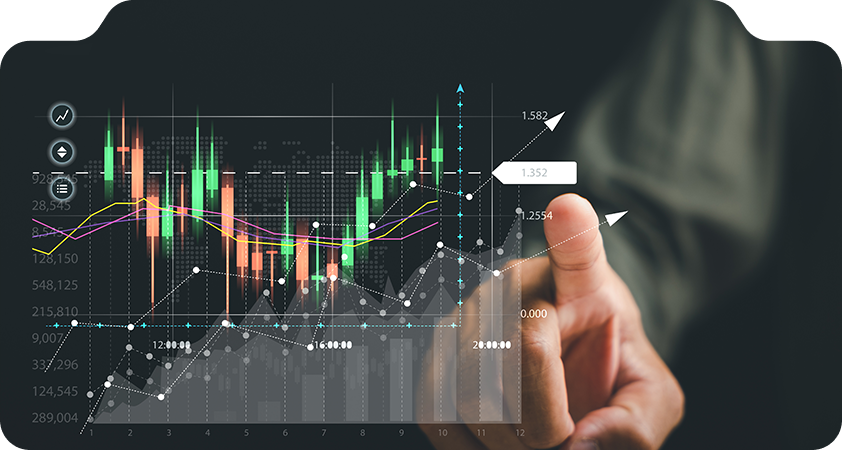
A price chart displaying an asset’s open, high, low, and close prices for a set period.
Contract Size
The standardized amount of an asset represented in a trading contract.
Drawdown
The reduction in account equity due to losing trades or positions.
Diversification
The practice of spreading investments across different assets to manage risk.
Equity
The total value of a trading account, including balance and unrealized profits or losses.
Execution
The process of completing a buy or sell order in the market.
Forex (Foreign Exchange)
The market for trading currencies against each other.
Fill
The execution of a buy or sell order at a specified price in the market.
Index
A statistical measure of the performance of a group of assets, such as stocks.
Inflation
The rate at which the general level of prices for goods and services rises.
Leverage
A tool allowing traders to control larger positions with less capital.
Liquidity
The ease with which an asset can be bought or sold in the market without affecting its price.
Margin
The amount of funds required to open and maintain a leveraged position.
Market Order
An order to buy or sell an asset at the best available price.
Pip (Percentage in Point)
The smallest price movement in forex trading, usually in the fourth decimal.
Portfolio
A collection of financial assets, such as stocks, bonds, or currencies.
Risk Management
The strategy used to minimize potential losses in trading.
Resistance
A price level where an asset faces selling pressure, making it difficult to move higher.
Spread
The difference between the bid and ask price of an asset.
Support
A price level where an asset tends to stop falling, with buying pressure increasing.
Take Profit
An order placed to close a trade once a specified profit target is reached.
Trailing Stop
A type of stop-loss order that moves with the market price, locking in profits as the price moves favorably.
Volatility
A measure of how much an asset’s price fluctuates over time.
Volume
The total number of shares or contracts traded in a particular asset or market.
Start Your Trading Journey with iM Global Partner
Join iM Global Partner today and take the first step toward mastering global markets. With powerful tools, top-notch security, and expert support, you’re ready to start trading with confidence.